

Degrowth School Programme 2026
Date and location:
September 17, 2026
Slovenia
Degrowth School Programme 2026: New Utopias for a Dystopian World
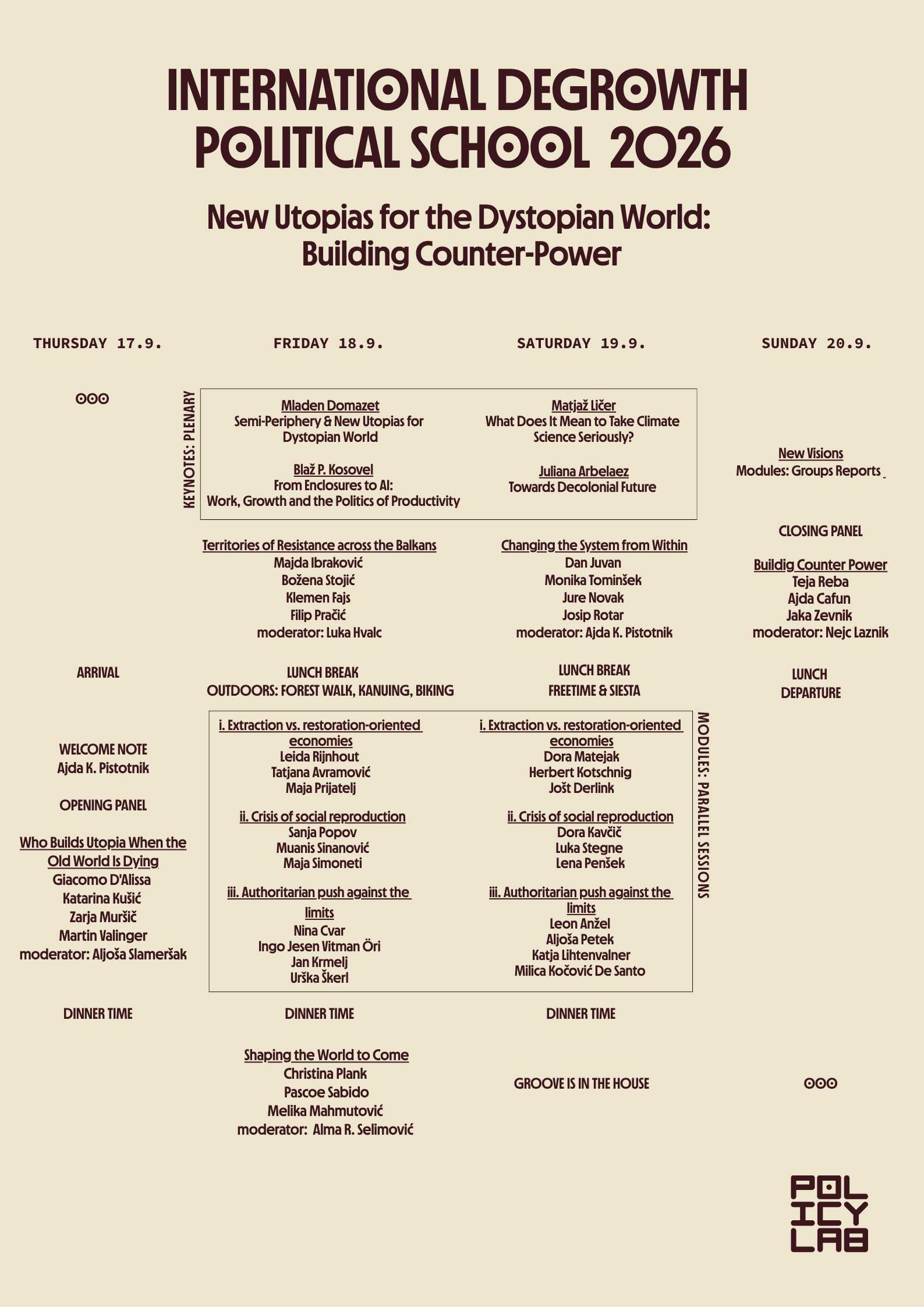
We are publishing the first outline of the programme for the International Degrowth Political School 2026, which will take place in Kostanjevica na Krki from 17 to 20 September 2026.
This year’s school, titled New Utopias for the Dystopian World: Building Counter-Power, asks how, in a time of ecological collapse, growing social inequalities, extractivism, militarisation and the rise of authoritarianism, we can imagine new political possibilities and build different forms of social power from below.
The 2026 programme will guide participants from the diagnosis of contemporary crises towards the question of how ideas of degrowth, ecological justice, democracy and solidarity can be translated into concrete strategies, alliances and forms of action.
Programme highlights 2026
The school will open with the panel Who Builds Utopia When the Old World Is Dying, featuring Giacomo D’Alisa, Katarina Kušić, Zarja Muršič and Martin Valinger, moderated by Aljoša Slameršak. The opening discussion will address one of the central questions of the school: who builds new utopias today, as the old political and economic order becomes increasingly exhausted?
The central part of the programme will feature four plenary lectures.
Mladen Domazet will speak about the semi-periphery, new utopias and the rise of authoritarianism. Blaž P. Kosovel, in his lecture From Enclosures to AI: Work, Growth and the Politics of Productivity, will connect the history of work, productivity, enclosures and artificial intelligence as a new frontier of capitalist expansion. Matjaž Ličer, in What Does It Mean to Take Climate Science Seriously?, will open the question of what climate science tells us today about the state of the planet and what politically follows from this. Juliana Arbelaez, in Towards Decolonial Future, will reflect on decolonial futures, development and global inequalities.
The programme will also include the discussion Territories of Resistance across the Balkans, dedicated to experiences of resistance, environmental struggles and political organising in the region, as well as the panel Changing the System from Within, which will address the possibilities and limits of acting within institutional politics.
The evening conversation Shaping the World to Come, with Christina Plank, Pascoe Sabido and Melika Mahmutović, will explore what kinds of political practices, conflicts and alliances can shape a different world.
An important part of the school will be the parallel modules, where discussions will be deepened across three thematic streams:
1. Extractivism and restoration-oriented economies
How do we move beyond economies that extract from people, communities, and natural resources, and build one oriented toward regeneration, repair, care, and meeting real needs instead? This module looks at extractivism, “green” capitalism, and the politics of land and natural resources, alongside the political possibilities of economies built on regeneration, repair, and shared needs.
2. The crisis of social reproduction
How do we secure housing, public services, care, and dignified work, the social infrastructure a good life depends on, without economic growth as the price of admission? This module examines labour, housing, public services, care work, and social infrastructure, and what it takes to organise them around dignified life rather than growth.
3. Authoritarian pressure against planetary and social limits
How do we respond to political forces attacking democracy, solidarity, climate policy, and ecological limits themselves? This module looks at the growing backlash against ecological limits, justice, democracy, and solidarity, examining how authoritarian forces deepen fossil-fuel dependency, spread disinformation, and undermine the collective capacity for change, while asking how progressive movements can build counter-power in response.
The modules will bring together researchers, activists, civil society organisations, cultural workers, urbanists, environmental advocates and political actors from Slovenia, the Balkans and wider Europe.
The school will conclude with group presentations and the closing panel Building Counter-Power, featuring Teja Reba, Ajda Cafun and Jaka Zevnik, moderated by Nejc Laznik. The closing session will focus on how the discussions, ideas and connections developed during the school can be translated into further political action.
Full program HERE
